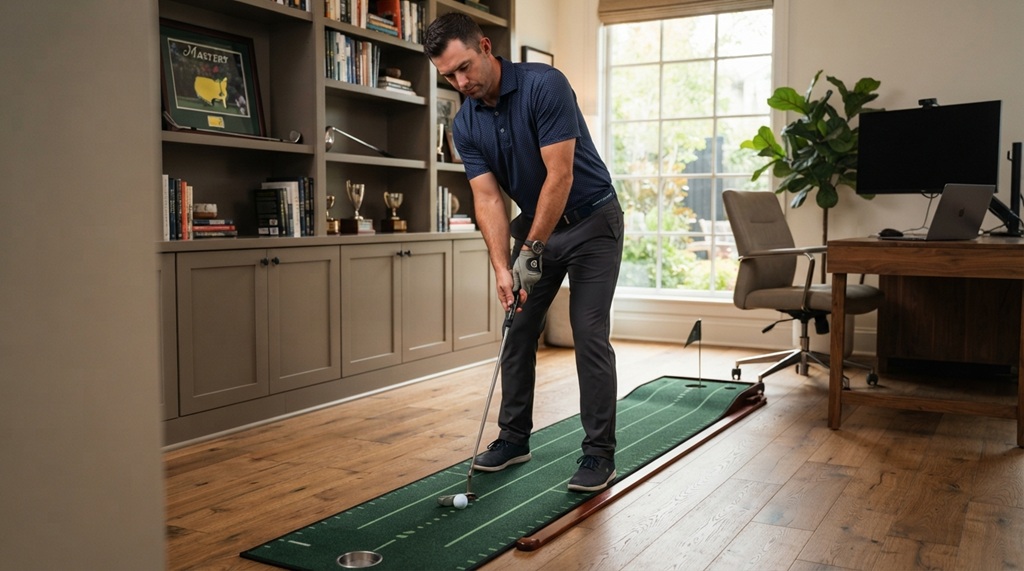
When the weather turns ugly or your schedule simply doesn’t allow for a trip to the course, your short game is usually the first thing to suffer. You can still make significant progress without leaving your living room. Learning how to practice putting indoors effectively requires more than just rolling a ball at a coffee mug. It demands a structured approach, the right tools, and a focus on technique over distance. This guide will show you exactly how to build a professional-grade practice routine at home, covering everything from setup to drills that actually translate to lower scores on the green.
Why Indoor Putting Practice Is So Effective
Putting is the most technique-driven part of golf, and it’s the one area where you don’t need a full swing to improve. Indoor practice allows you to isolate the stroke without worrying about ball flight or distance control from a full swing. This is where you build the neural pathways for a consistent, repeatable motion. By focusing on the mechanics in a controlled environment, you can develop a stroke that holds up under pressure. Many golfers find that spending just 15 minutes a day on a putting mat yields better results than an hour at the driving range. It’s about quality repetition, not just quantity.
The Key Difference: Distance vs. Direction
Most amateur golfers obsess over line, but professionals know that distance control is actually more important. A putt hit on the wrong line but with perfect speed has a chance to drop; a putt hit on the right line with terrible speed has almost no chance. When you practice putting indoors, you have the unique opportunity to focus intensely on the pace of your stroke. Without the distraction of reading a complex green, you can train your hands and body to deliver the putter face consistently to the ball, which is the primary driver of distance control.
Setting Up Your Indoor Putting Station
You don’t need a massive room or expensive equipment to get a pro-level practice session. The goal is to create a space where the floor is perfectly flat and you have enough room to make a full, comfortable stroke. A hallway or a spare bedroom works best. You need about 8 to 10 feet of uninterrupted space to practice effectively. The surface matters more than the length. A hard floor will roll faster than a carpet, so you need to be aware of how the surface affects your speed.
Choosing the Right Surface and Mat
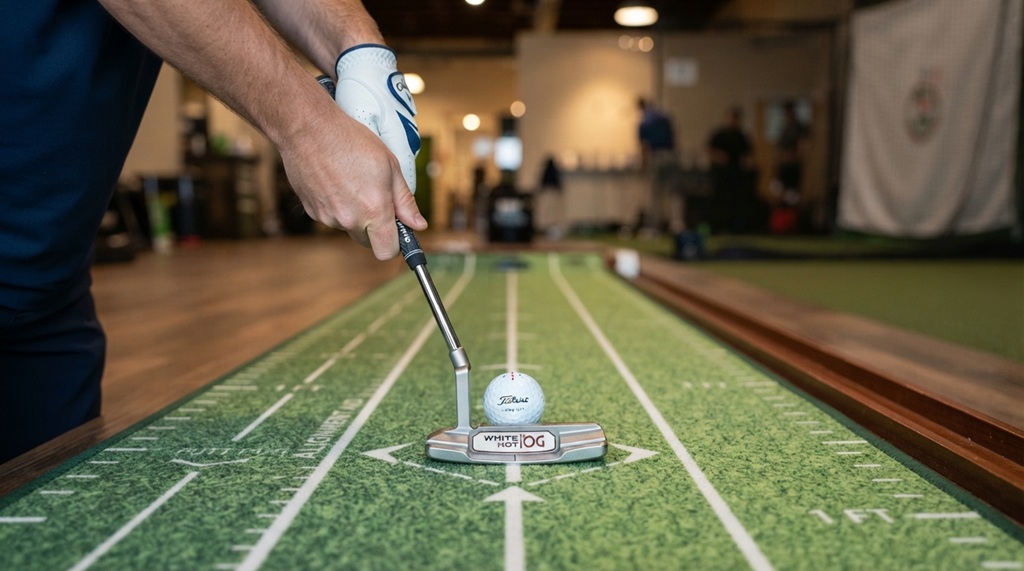
A high-quality putting mat is your primary tool. Look for one that has a realistic speed and a true roll. Many mats come with alignment lines and distance markers, which are excellent for feedback. If you are looking for a comprehensive setup, you might want to check out some of the top-rated options that include alignment tracks and target cups. The best mats have a “stimpmeter” rating similar to a real green, usually between 9 and 11. This ensures that the ball rolls at a speed that mimics what you will encounter on the course.
Essential Tools for Feedback
Beyond the mat, you need tools that give you immediate feedback. A simple mirror is one of the most underrated training aids. Placing a mirror beside your putting line allows you to check your eye position and head stability. You also need a set of alignment rods or a laser line to ensure your shoulders are square to the target. A putting gate—two small obstacles that the ball must pass through—is crucial for grooving a square stroke path. These tools are cheap but incredibly effective for building muscle memory.
Core Drills to Build a Pro Stroke
Mastering a tour-caliber putting stroke indoors requires transitioning from casual repetition to deliberate, structured practice that isolates critical mechanical variables, and while refining your short-game mechanics indoors ultimately drives down your scores, addressing long-game consistency is equally vital to your overall performance, meaning that pairing your indoor putting sessions with insights on how the Callaway Paradym helps high handicappers hit straighter will seamlessly bridge the gap between your living room practice and full-swing execution on the course.
The Gate Drill for a Square Face
This is the gold standard for developing a straight-back-and-straight-through stroke. Place two tees or alignment rods just wider than your putter head, about 6 inches in front of the ball. Your goal is to stroke the ball through the gate without hitting the tees. This forces you to keep the putter face square to the target line through impact. Start with a wider gate and gradually narrow it as you improve. This drill eliminates the “push” or “pull” that plagues many amateur strokes.
The Distance Ladder for Speed Control
Place three tees or markers at 3, 6, and 9 feet from the hole. Start at the 3-foot mark and hit five putts. Your goal is to have every ball finish past the hole but within a putter-length of it. Move to the 6-foot mark and repeat. This drill trains your brain to associate the length of your backswing with the distance the ball travels. It is the most effective way to improve your lag putting and eliminate the dreaded “three-putt.”
The Coin Drill for Center Contact
Place a coin (or a business card) directly under the ball on the mat. Your goal is to strike the ball and the coin simultaneously. If you hit the ball without the coin, you are hitting up on the ball. If you hit the coin first, you are hitting down too steeply. This drill ensures you are striking the equator of the ball with a slight forward press, which creates the top spin needed for a consistent roll. This is a subtle but critical detail that separates good putters from great ones.
Tracking Your Progress and Metrics
To practice like a pro, you need to measure your performance. You cannot improve what you do not measure. Keep a simple notebook or use a spreadsheet to track your success rate on the drills. For example, record how many putts you make out of 10 from the 3-foot mark. Over time, you should see this number climb. This data provides objective feedback and keeps your practice sessions focused. It also helps you identify specific weaknesses, such as a tendency to miss left on short putts.
Understanding the “Make Percentage”
Professionals track their make percentage from various distances. You should do the same. On your mat, mark distances of 3, 5, and 8 feet. Hit 10 putts from each distance and record your score. A good target for an amateur is 80% from 3 feet, 50% from 5 feet, and 20% from 8 feet. If you fall short of these benchmarks, you know exactly where to focus your next session. This turns a vague feeling of “I need to practice” into a specific action plan.
Common Mistakes to Avoid Indoors
Practicing indoors has its own set of pitfalls. The most common mistake is practicing on a surface that is too slow. If your mat rolls much slower than a real green, you will develop a “hit” instinct rather than a “stroke” instinct. You will start to jab at the ball to get it to the hole, which destroys your tempo. Always ensure your mat is fast enough to mimic real conditions. Another mistake is practicing without a target. Simply hitting the ball to the end of the mat does not simulate the pressure of a real putt.
Ignoring the Follow-Through
Many golfers focus so much on the backswing that they forget the follow-through. A proper putting stroke involves a smooth, controlled acceleration through the ball. Your putter should decelerate naturally after impact, not stop abruptly. To fix this, practice making strokes where you hold your finish position for a full two seconds. This trains your muscles to complete the motion, which is essential for consistent distance control. It also prevents the “yips” that come from a jerky, stop-start motion.
Building a Daily Routine
Consistency is more important than duration. A 15-minute daily session is far more effective than a 2-hour session once a week. Your routine should be structured to cover all the fundamentals: alignment, stroke path, and distance control. Start with the gate drill for 5 minutes to groove your path. Move to the distance ladder for 5 minutes to dial in your pace. Finish with the coin drill for 5 minutes to ensure solid contact. This simple routine covers all the bases and takes less time than a coffee break.
Simulating Pressure at Home
One of the hardest things to replicate indoors is pressure. However, you can create it. Set a goal for yourself before each session. For example, “I must make 15 putts in a row from 3 feet before I can stop.” This forces you to focus and execute under self-imposed stress. You can also create a “tournament” where you have to make a 5-foot putt to win. This mental rehearsal is invaluable for building the confidence you need on the course.
Frequently Asked Questions
How long should I practice putting indoors?
Fifteen to twenty minutes of focused practice is ideal. This is enough time to complete a structured routine without losing concentration. Quality repetition is more valuable than long, unfocused sessions that lead to fatigue and poor mechanics.
Do I need an expensive putting mat?
No, but you need a mat with a realistic speed. A cheap mat that rolls too slowly will harm your tempo. Look for a mat that has a stimpmeter rating between 9 and 11 to accurately mimic real green conditions.
Can I practice putting on my carpet?
You can, but it is not recommended. Most household carpets are too slow and have inconsistent surfaces. This will lead to a “hit” instinct rather than a smooth stroke. A dedicated mat provides a consistent, true roll that is essential for building muscle memory.
How often should I replace my putting mat?
Most quality mats will last for years if they are stored properly. However, if you notice the surface becoming shiny or the ball starting to bounce, it is time to replace it. A worn mat will not give you accurate feedback on your stroke.
What is the most important aspect of indoor putting?
Distance control is the most important aspect. While line is important, speed is what determines whether you have a makeable second putt. Focus on training your stroke length to control distance, and you will see your scores drop.
Conclusion
Practicing putting indoors is not just a way to pass the time during the offseason; it is a legitimate method for lowering your scores. By setting up a dedicated station, using structured drills, and tracking your progress, you can build a stroke that is mechanically sound and reliable under pressure. The key is to practice with intention, focusing on the process rather than just the outcome. Commit to a short daily routine, and you will be amazed at the confidence you bring to the first green. Your living room can become the most valuable practice facility you own.